EN
EN



Outdoor lighting directly affects safety, productivity, and operating costs for commercial and industrial facilities. A well-chosen LED area light delivers measurable improvements in both visibility and energy consumption, making it one of the most impactful upgrades a facility manager can implement. Whether the goal is to illuminate a parking lot, a warehouse yard, a sports complex, or a public roadway, the right LED area light transforms how an outdoor space functions after dark.
Understanding how an LED area light achieves these improvements requires examining its optical design, driver technology, thermal management, and control capabilities. Each LED area light component works together to push light exactly where it is needed while minimizing wasted energy. This article explains the specific mechanisms through which an LED area light enhances outdoor visibility and efficiency, and outlines the practical considerations that guide a smart LED area light selection.
How an LED Area Light Enhances Outdoor Visibility
Optical Precision and Light Distribution
The most fundamental way an LED area light improves visibility is through controlled light distribution. Unlike older high-pressure sodium or metal halide fixtures, a modern LED area light uses precision-engineered optics that direct output into a defined pattern — Type II, III, IV, or V — depending on the mounting location and coverage requirement. This means an LED area light placed on a parking lot pole delivers uniform illumination across the target surface rather than wasting lumens upward into the sky or sideways onto adjacent properties. Uniform light from an LED area light reduces dark spots, shadow zones, and contrast glare, all of which impair human vision and create safety risks.
High-quality LED area light fixtures achieve a high Color Rendering Index, typically above 70 and often above 80. A strong CRI means that an LED area light renders colors and surface details accurately, which is critical for security camera performance and for drivers and pedestrians making real-time decisions in low-light environments. When a facility replaces older HID lamps with a modern LED area light, the immediate visual improvement is noticeable even when raw lumen output remains similar, because the LED area light directs light more usefully.
Consistent Lumen Output Over Time
An LED area light maintains consistent output across its rated lifespan far better than conventional technologies. Traditional HID sources degrade significantly within the first few thousand operating hours, producing dimmer and often color-shifted light long before the lamp fully fails. An LED area light, by contrast, maintains a high percentage of its initial lumen output well past 50,000 hours under proper thermal conditions. This lumen maintenance means the LED area light continues to serve its visibility function reliably, reducing the frequency of emergency re-lamping that leaves zones temporarily underlit.
How an LED Area Light Delivers Energy Efficiency
Efficacy and Wattage Reduction
Energy efficiency in an LED area light begins at the chip level. Modern LED area light modules achieve efficacy ratings above 130 lumens per watt, and premium LED area light products can exceed 160 lumens per watt. This is roughly three to four times the efficacy of standard metal halide, meaning a single LED area light can replace a 400-watt HID fixture while drawing only 100 to 150 watts. When multiplied across dozens or hundreds of poles in a large facility, the wattage reduction from switching to LED area light translates into substantial monthly electricity savings. A well-specified LED area light project typically delivers a payback period of two to four years through energy cost reduction alone.
Smart Controls and Adaptive Performance
A modern LED area light integrates with dimming controls, occupancy sensors, and daylight harvesting systems. An LED area light equipped with a 0–10V dimming driver can be scheduled to run at full output during peak hours and step down to 30 or 50 percent during low-traffic periods late at night. This adaptive operation further cuts energy consumption per LED area light well beyond the savings already achieved by switching from HID. Some LED area light models support wireless networked control, allowing facility managers to monitor energy use, set schedules, and receive fault alerts for every LED area light in the system from a single dashboard. These capabilities make an LED area light not just a lamp replacement but an intelligent lighting asset.
Thermal management is also central to LED area light efficiency. An LED area light that runs too hot degrades faster and produces fewer lumens per watt. Well-designed LED area light housings use die-cast aluminum heat sinks with optimized fin geometry to dissipate heat passively. A thermally stable LED area light maintains its rated efficacy and lifespan, ensuring the energy efficiency benefit persists over the full service life of the fixture.
Practical Selection Factors for Outdoor LED Area Light Projects
Mounting Height, Spacing, and Photometric Planning
Selecting the correct LED area light for an outdoor project requires photometric analysis. Mounting height, pole spacing, and target illuminance levels determine which LED area light wattage and distribution type will deliver code-compliant uniformity. A photometric study using IES files supplied by the LED area light manufacturer produces a simulated light map before any installation begins. This prevents over-lighting, which wastes energy, and under-lighting, which defeats the visibility purpose of the LED area light entirely. For parking lots, a minimum average of 1 to 2 footcandles with a uniformity ratio better than 4:1 is a common design target, and a well-matched LED area light makes this achievable.
Ratings and Certifications for Outdoor Durability
An outdoor LED area light must withstand rain, humidity, dust, and temperature extremes. An IP65 or higher ingress protection rating confirms that the LED area light housing resists water jets and fine particle infiltration. IK ratings confirm resistance to mechanical impact. For coastal or industrial environments, an LED area light with corrosion-resistant finish and stainless hardware extends service life significantly. Certifications such as UL listing and DLC qualification give facility managers confidence in both the safety and the energy efficiency claims of the LED area light being specified.
FAQ
What lumen output should I look for in an LED area light for a large parking lot?
For a large parking lot, an LED area light in the 20,000 to 30,000 lumen range mounted at 20 to 25 feet is typically sufficient. A photometric study using the specific LED area light IES file will confirm whether the chosen LED area light meets the required average illuminance and uniformity for the site.
Can an LED area light work with existing poles and mounting hardware?
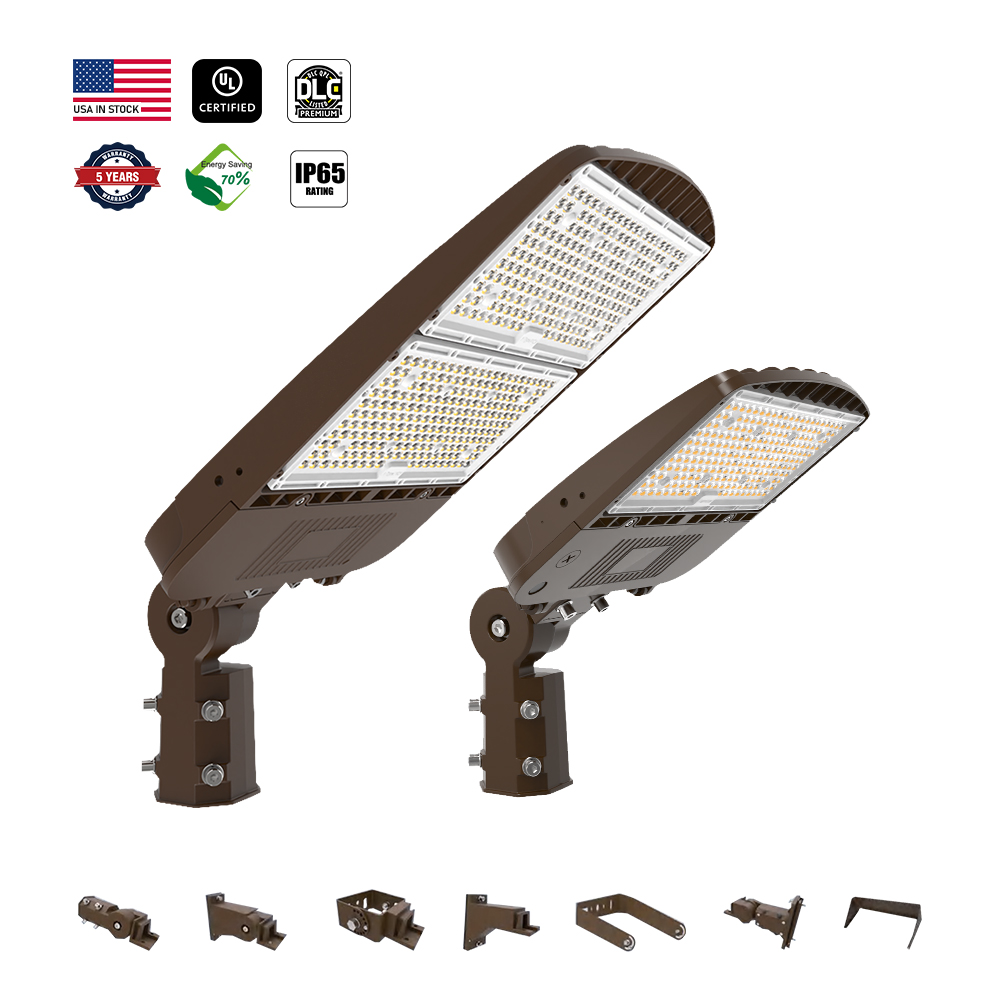
Most LED area light fixtures are designed to fit standard 2-inch and 3-inch tenon mounts, making it straightforward to retrofit an existing pole with a new LED area light. Always verify the weight and wind load rating of the existing pole against the specifications of the replacement LED area light before installation.
How long does a quality LED area light typically last?
A quality LED area light is rated for 50,000 hours or more at L70, meaning the LED area light retains at least 70 percent of its initial lumen output at that point. In a typical outdoor application running 12 hours per night, this means an LED area light can last over 10 years before a replacement is needed.